

Global digital trade initiatives often use a four-corner network model: a supplier (Corner 1) sends an e-document to its service provider (Corner 2), which routes it via a global directory to the buyer’s provider (Corner 3), and finally to the buyer (Corner 4). For example, the PEPPOL e-invoicing network uses an XML standard (Peppol BIS), enabling accounting systems to “connect once and connect to all” via certified Access Points. This level of interoperability reduces fragmentation, creating a consistent invoicing experience for businesses around the world.
However, many modern systems are now incorporating a fifth corner – often a tax or trust authority – into this structure. This 5-Corner Model includes a central hub or regulatory platform that receives and processes invoice data, offering an additional layer of compliance and oversight.
*Corner 1: Supplier generates an invoice using electronic invoicing software.
*Corner 2: Supplier’s Access Point forwards it to the buyer’s Access Point.
*Corner 3: Buyer’s Access Point receives and processes the document.
*Corner 4: Buyer receives the invoice.
All exchanges are peer-to-peer, facilitated by service providers. The transaction completes once the buyer receives the document.
In addition to the four steps above, Access Points also send a copy to the Tax Authority Platform (Corner 5). This central hub may validate, timestamp, or store the invoice.
This hybrid model blends private-sector interoperability with real-time regulatory visibility. In countries like Malaysia, this approach is part of national E-invoicing solutions designed to enhance compliance and digital governance.
1. Real-Time Trust and Compliance
With real-time access to invoice data, tax authorities can:
*Detect fraud instantly
*Improve tax revenue collection
*Match invoicing data with declared taxes accurately
This is particularly important in regions adopting PEPPOL-certified e-invoicing platforms, such as Malaysia, where authorities require instant access to B2B transaction data.
2. Enhanced Resilience
Fully centralized clearance systems often create single points of failure. The decentralized nature of the 5-corner model avoids this by distributing responsibilities among service providers. Even if one Access Point fails, invoices can still be transmitted via the others.
3. More Innovation, Less Restriction
Decentralization allows businesses to continue using their electronic invoicing software. Certified Access Points ensure compliance with evolving tax laws while enabling companies to choose from the best e-invoicing software in Malaysia and beyond. Innovation remains in the hands of the private sector.
4. Built on Interoperable Standards
The 5-corner model leverages existing infrastructure, such as the PEPPOL e-invoicing network and UBL/XML standards, making transitions smoother for businesses. This prevents costly reinvestment while maintaining consistent, scalable operations across borders.
With SmarteIS from Skill Quotient Technologies , businesses can enjoy a seamless invoicing experience that combines user-friendly design, automation, customization, integration, compliance, and insightful analytics—all in one powerful solution.
Book a Demo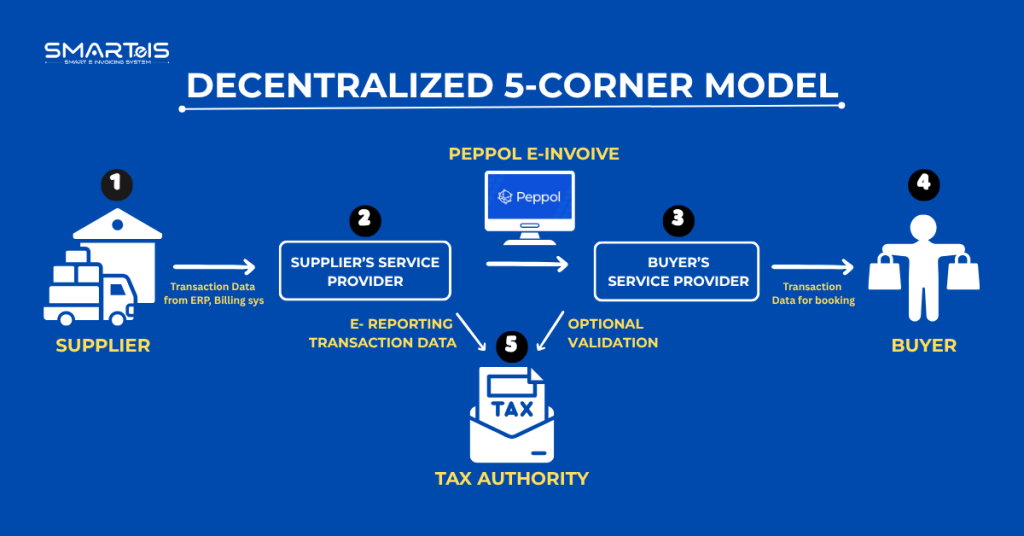
*France: France’s B2B e-invoicing system adopts the 5-corner model by mandating that certified providers transmit invoice data to tax authorities.
*Spain and Belgium: These countries are gradually integrating tax reporting into the PEPPOL infrastructure.
*European Union: The EU’s “VAT in the Digital Age” initiative favors the 5-corner approach, aiming to avoid overly centralized systems.
*Singapore (Invoice Now): By 2025, Singapore will require businesses to submit invoice data to IRAS via Access Points.
*Malaysia: As part of its digital tax strategy, Malaysia is implementing a PEPPOL-based 5-corner model that mandates invoice sharing with LHDN (the tax authority).
*UAE & Mexico: These countries use tax-clearing platforms certified to ensure that both recipients and authorities receive every invoice simultaneously.
The 5-corner concept extends beyond e-invoicing. For example, decentralized identity systems (such as those using blockchain or W3C’s DID standards) mirror this structure by distributing verification and trust across multiple parties, not just one central authority. This trend reinforces the global shift toward resilient, standards-based trust systems.
Malaysia is rolling out E-invoicing solutions that align with the 5-corner model. Businesses will need to:
*Use PEPPOL-certified e-invoicing platforms
*Ensure their Access Points can communicate with LHDN
*Choose reliable electronic invoicing software that simplifies compliance
This approach future-proofs businesses for seamless trade, both locally and internationally.
The 5-Corner Model is a forward-thinking upgrade to digital invoicing. It combines the efficiency of peer-to-peer invoice exchange with real-time oversight by tax authorities. PEPPOL’s “connect once, connect to all” remains central, allowing seamless cross-border trade. This model ensures stronger trust, operational reliability, and compliance without slowing innovation. As Malaysia adopts this approach, businesses should opt for PEPPOL-certified e-invoicing platforms that are resilient, interoperable, and compliant with national regulations.
Skill Quotient Technologies © 2025. All rights reserved.
Ask about Smarteis