The insurance industry plays a vital role in the UAE’s economy, providing essential risk management solutions and contributing significantly to the nation’s financial stability. With the UAE’s mandatory e-invoicing system set to launch in July 2026, insurance companies must prepare for a transformative shift in how they manage invoices, claims, and financial documentation.
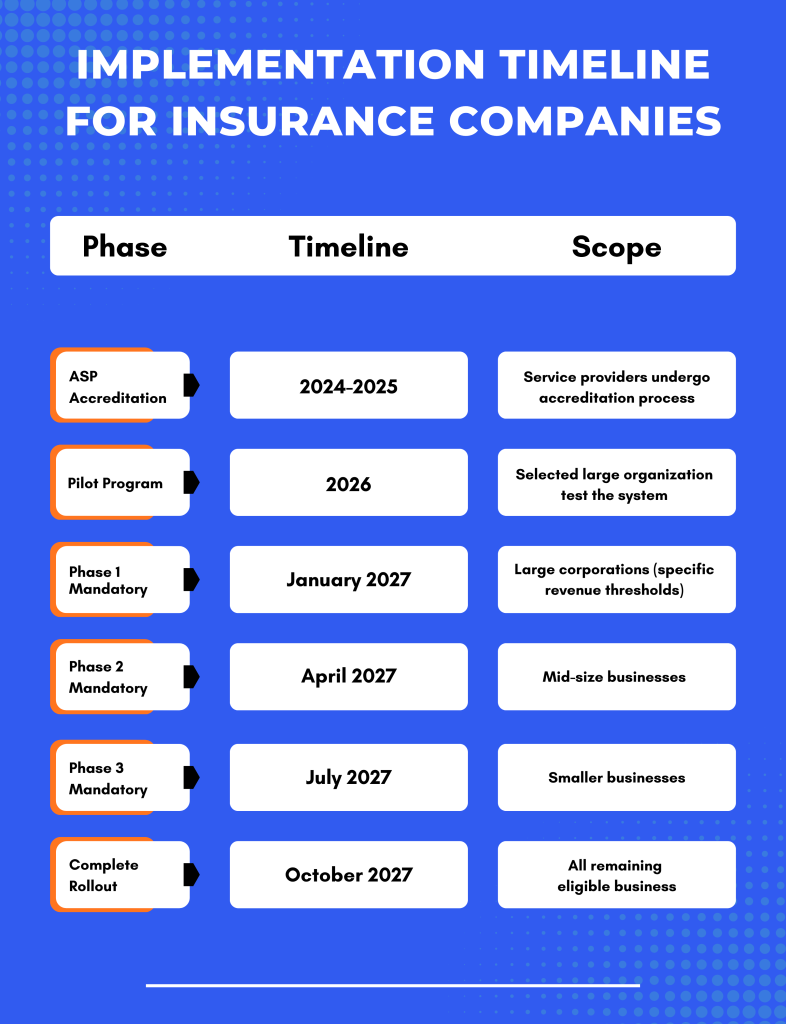
The UAE Ministry of Finance has announced a phased implementation of e-invoicing, starting with a pilot program in July 2026, followed by mandatory compliance for large corporations by January 2027 and a complete rollout through October 2027. This article provides a comprehensive guide to e-invoicing requirements specifically for the insurance industry in the UAE.
Understanding UAE’s E-Invoicing Framework
The UAE’s e-invoicing system is based on the Peppol (Pan-European Public Procurement Online) framework and requires all B2B and B2G transactions to be exchanged through Accredited Service Providers (ASPs). Unlike traditional invoicing, e-invoicing involves real-time digital exchange of structured invoice data in formats such as XML or UBL (Universal Business Language).
Key Features of UAE E-Invoicing:
Structured Format: Invoices must be created in XML or JSON using UBL or PINT standards
ASP Requirement: All e-invoices must be transmitted through Ministry of Finance-accredited service providers
Real-Time Reporting: E-invoices must be reported to the Federal Tax Authority (FTA) within days of issuance
Tamper-Proof: All electronic invoices must remain verifiable and maintain integrity
Note: The Central Bank of the UAE (CBUAE) supervises and regulates the insurance sector. Insurance companies should coordinate with both the Ministry of Finance and CBUAE regarding specific compliance requirements.
Scope of E-Invoicing for Insurance Companies in UAE
The insurance industry in the UAE handles diverse financial transactions across B2B and B2C channels. E-invoicing requirements extend to all primary and secondary revenue and expense sources.
Major Revenue Sources Requiring E-Invoicing
Premium Income: Individual policies, group policies, corporate policies
Renewal Premiums: Annual, semi-annual, and monthly premium renewals
Policy Endorsements: Changes to existing policies that affect premium amounts
Reinsurance Income: Premium income from reinsurance arrangements
Commission Income: Fees earned from insurance intermediaries or agents
Investment Income: Where applicable to policy-related investments
Service Fees: Policy issuance fees, administrative charges, processing fees
Late Payment Charges: Interest and penalties on overdue premiums
Expenses Requiring E-Invoices
Claims Payments: Insurance claims settled with policyholders or third parties
Reinsurance Premiums: Payments to reinsurers
Commission Expenses: Payments to agents, brokers, and intermediaries
Professional Services: Legal, actuarial, and consulting fees
Third-Party Services: Medical assessments, vehicle inspections, loss adjusters
IT Services: Policy management systems and software
Marketing and Distribution: Advertising and promotional expenses
Consolidated E-Invoicing for Insurance Companies
Can Insurance Companies Issue Consolidated E-Invoices?
Yes, insurance companies can issue consolidated e-invoices for transactions where policyholders do not require individual e-invoices. This is particularly relevant for B2C transactions.
Consolidated E-Invoice Guidelines:
Aggregate multiple transactions from policyholders who don’t need individual e-invoices
Issue consolidated e-invoices within seven calendar days after the end of the month
Maintain regular statements or bills according to current business practices (these don’t require FTA validation)
Annual premium statements can be used to create consolidated e-invoices
Annual Premium Statements
Insurance companies can use annual premium statements to create consolidated e-invoices for policyholders who don’t require individual invoices. For example:
If an annual premium statement covering January 2026 to December 2026 is available in February 2027, the full year’s data can be transmitted at that time
There’s no need to exclude periods before the e-invoicing implementation date.
Key E-Invoicing Scenarios for Insurance Policies
Individual Policyholders
Can individual policyholders request e-invoices for products not eligible for tax relief?
Yes, policyholders can request an e-invoice regardless of the product’s eligibility for tax benefits. Insurance companies must issue an e-invoice upon the policyholder’s request.
What information must be included in e-invoices?
Insurance companies must provide a detailed breakdown of premiums paid, including:
Life insurance premiums
Medical insurance premiums
General insurance premiums
Appropriate classification codes as per FTA requirements
Joint Insurance Policies
For joint insurance policies (e.g., property insurance covering two policyholders):
Issue one e-invoice per insurance policy
The principal policyholder receiving the invoice should be indicated as the Buyer
If the other policyholder requests an e-invoice, issue a separate e-invoice to that policyholder
Collections on Behalf
How should insurance companies handle collections on behalf (stamp duty, third-party fees, etc.)?
There are two scenarios:
Scenario 1: If the e-invoice for collections on behalf is issued to the insurance company:
Include these collections in the e-invoice to the policyholder
These collections won’t be recognized as the insurance company’s income
Use appropriate classification codes
Scenario 2: If the e-invoice for collections on behalf is issued directly to the policyholder:
Collections on behalf don’t need to be included in the insurance company’s e-invoice
Insurance Products Sold Through Intermediaries
Two Main Distribution Scenarios
Scenario 1: Master Policy
Contract between insurance company and intermediary (broker/corporate)
End customers are insured persons under the master policy
Intermediary is the policyholder
Scenario 2: Individual Policy
Contract between insurance company and end customer
Intermediary facilitates the sale but is not the policyholder
End customer is the direct policyholder
E-Invoice Handling for Different Scenarios
For Master Policies (Scenario 1):
Issue e-invoice to the intermediary (the policyholder)
If the intermediary requests separate e-invoices for individual insured persons, insurance companies may accommodate this based on current business processes
For Individual Policies (Scenario 2):
Issue e-invoice directly to the end customer (the policyholder)
Even if premiums flow through intermediaries, the e-invoice goes to the actual policyholder
Group Policies
How should group policies be handled?
If individual policies are issued to each group entity, issue separate e-invoices to each entity
If only one group policy exists, issue the e-invoice to the master policyholder
Insurance companies can issue separate e-invoices to entities under a master group policy if customers request it
Employer-Employee Insurance Arrangements
When employers collect insurance contributions from employees and pay the insurance company:
The policyholder determines who receives the e-invoice
If the employee is the policyholder, issue the e-invoice to the employee
Employer collection is solely a settlement mechanism and doesn’t change the policyholder relationship
Minor Policyholders
When the policyholder is below 18 years of age:
The Buyer for e-invoicing purposes is the policyholder
However, for minors, use the parent’s or guardian’s details as the Buyer in the e-invoice
Alternatively, use any other relevant party as applicable under UAE law
Cash Before Cover Policies
The “cash before cover” practice, where payment precedes policy issuance, can continue with e-invoicing implementation:
Insurance companies can issue invoices upon policy issuance
For B2B/group transactions, issue when premiums are due
For B2C transactions involving life, medical, and education policies, annual statements remain acceptable
Current processes can continue with no changes to existing practices
Claims, Compensation, and Benefit Payments
Self-Billed E-Invoices for Claims
Insurance companies must issue self-billed e-invoices for:
Self-billed e-invoices apply to both individual and business recipients
The Supplier in the self-billed invoice is the policyholder/beneficiary
This applies regardless of who receives the claim payment (hospitals, workshops, attorneys, etc.)
Consolidated self-billed e-invoices are permitted for claims and benefit payments to individuals not engaged in business
Disposal of Scrap or Wreckage
Is an e-invoice required for workshops/salvage contractors?
The requirement depends on asset ownership:
If the insurance company owns the damaged asset: The workshop/salvage contractor should issue an e-invoice to the insurance company
If the policyholder owns the damaged asset: The policyholder should receive the e-invoice from the workshop/salvage contractor
Knock-for-Knock Arrangements
In cases where Driver A claims against their insurer while investigation is ongoing for an accident involving Vehicle B:
For Insurance Claims:
Each driver receives a self-billed e-invoice from their respective insurance company
For Recoupment Between Insurers:
Driver B’s insurance company issues a self-billed e-invoice to Driver B (even though payment goes to Driver A’s insurer)
If Driver A’s insurance company previously issued a self-billed e-invoice to Driver A:
Within 72 hours: Cancel the original e-invoice
After 72 hours: Issue a self-billed credit note e-invoice
Policy Refunds and Cancellations
Refund Note E-Invoices
When a policy is terminated and involves a premium refund:
Insurance companies must issue a refund note e-invoice to the policyholder
Follow current billing and invoicing procedures
Exceptions (no refund note required):
Payments made in error by policyholders
Overpayments
Return of security deposits
Reinsurance Transactions
E-Invoice Treatment for Reinsurance
Reinsurance Services and Expense Recoveries:
From Cedant’s Perspective (Insurance Company):
Reinsurance Premiums Paid: Receive e-invoice from reinsurer
Claims Recovery: Issue self-billed e-invoice to the reinsurer (Supplier = reinsurer)
From Reinsurer’s Perspective:
Reinsurance Premiums Received: Issue e-invoice to cedant
Claims Paid: Receive self-billed e-invoice from cedant (where reinsurer is the Supplier)
Important Note: E-invoices may present information on a net basis where applicable.
Agent Registration and Examination Fees
Scenario: Insurance company covers registration or examination fees for agents, paid to Insurance Associations or Examination Bodies, and later recovers from agents.
E-Invoice Treatment:
If the Association/Body issues the e-invoice to the insurance company:
The insurance company must include the amount in the e-invoice issued to the agent
This recovered amount is not classified as income for the insurance company
Apply appropriate classification codes per FTA requirements
If the Association/Body issues the e-invoice directly to the agent:
The insurance company doesn’t need to include these amounts in their e-invoice to the agent
Interfund Charges
Are interfund charges subject to e-invoicing?
Interfund charges within the same legal entity do NOT require e-invoicing. Examples include:
Investment-linked policy charges
Wakalah fees (for Takaful)
Actuarial surplus transfers
Internal fund management fees
However: If your insurance company currently issues invoices for these internal transactions, you may continue this practice after implementing e-invoicing.
Policy Endorsements and Amendments
Handling Policy Endorsements After E-Invoicing Implementation
For New E-Invoices:
If issuing a new e-invoice for the policy endorsement, include the FTA Unique Identifier Number from the original policy e-invoice in the “Reference Number” field
For Debit/Credit/Refund Notes:
If issuing a debit note, credit note, or refund note for the endorsement, include the original policy’s FTA Unique Identifier Number in the “Invoice Reference Number” field
VAT Considerations for Insurance E-Invoices
VAT Treatment in UAE Insurance
While implementing e-invoicing, insurance companies must also ensure correct VAT treatment:
Exempt Supplies:
Life insurance for UAE residents
Reinsurance for UAE residents
Zero-Rated Supplies:
Life insurance and reinsurance for recipients outside UAE or GCC
Standard-Rated Supplies (5% VAT):
General insurance (property, motor, etc.)
Health insurance premiums
All e-invoices must correctly reflect the applicable VAT treatment and include the required VAT registration numbers.
Exemptions and Special Cases
Potential Exemptions
Based on initial guidance, certain insurance-related transactions may have special treatment:
Some banking and insurance activities may be exempt from mandatory e-invoicing for specific transaction types
However, transactions directly related to primary business activities will require e-invoicing
Important: Current FTA-approved administrative exceptions and invoice exemptions will cease once e-invoicing becomes mandatory
Insurance companies should monitor FTA announcements for sector-specific guidance as the implementation date approaches.
Technical Requirements for Compliance
E-Invoice Format Requirements
All insurance company e-invoices must meet these technical specifications:
Digital Format: XML or JSON
Standard Schema: UBL (Universal Business Language) or PINT (Peppol Invoice Standard)
Transmission: Through FTA-accredited service providers only
Data Integrity: Tamper-proof and verifiable
Reporting: Submitted to FTA within the specified timeframe
Accredited Service Provider (ASP) Selection
Insurance companies must select and integrate with an ASP accredited by the UAE Ministry of Finance. ASPs must maintain:
Professional Indemnity Insurance: AED 2,500,000
Crime Insurance: AED 5,000,000
Cyber Fraud Insurance: AED 5,000,000
Preparing Your Insurance Company for E-Invoicing
Recommended Action Plan
Phase 1: Assessment (Now – Q2 2026)
Audit current invoicing processes across all policy types
Identify all revenue and expense categories requiring e-invoices
Map out claims processing and benefit payment workflows
Review reinsurance arrangements and invoicing procedures
Phase 2: System Integration (Q2 2026 – Q3 2026)
Select and contract with an accredited ASP
Integrate policy management system with e-invoicing solution
Update accounting and ERP systems
Implement self-billing capabilities for claims
Phase 3: Testing (Q3 2026 – Q4 2026)
Conduct end-to-end testing of e-invoicing workflows
Test consolidated invoicing for B2C transactions
Validate self-billed e-invoice generation for claims
Ensure proper handling of refunds, endorsements, and amendments
Phase 4: Training (Q4 2026 – Q1 2027)
Train finance and accounting teams
Educate underwriting and claims staff
Prepare customer service for policyholder inquiries
Brief intermediaries and distribution partners
Phase 5: Go-Live Support (Based on company phase)
Implement monitoring and exception handling
Maintain dual processes during transition period
Provide ongoing support to stakeholders
Common Challenges and Solutions
Challenge 1: Volume of B2C Transactions
Solution: Leverage consolidated e-invoicing for individual policyholders who don’t require separate invoices
Challenge 2: Complex Claims Workflows
Solution: Implement automated self-billed e-invoice generation integrated with claims management systems
Challenge 3: Intermediary Distribution Models
Solution: Clearly define policyholder relationships and establish protocols for direct vs. master policy e-invoicing
Challenge 4: Legacy System Integration
Solution: Work with ASPs offering robust APIs and middleware solutions for older policy administration systems
Challenge 5: Multi-Line Insurance Products
Solution: Ensure detailed premium breakdowns with proper classification codes for each line of business
Penalties and Non-Compliance
While specific penalties for e-invoicing non-compliance are yet to be detailed by UAE authorities, businesses should expect:
Fines for late or missing e-invoices
Potential VAT recovery restrictions
Administrative penalties for systematic non-compliance
Reputational risks with regulators (CBUAE and FTA)
Insurance companies should prioritize compliance to maintain their regulatory standing and operational licenses.
Key Takeaways for UAE Insurance Companies
Mandatory Compliance: E-invoicing is mandatory for UAE insurance companies starting July 2026 (phased approach)
Comprehensive Scope: Covers premiums, claims, commissions, reinsurance, and all major revenue/expense streams
Self-Billing for Claims: Insurance companies must issue self-billed e-invoices for all claims and benefit payments
Flexibility for B2C: Consolidated e-invoicing is available for individual policyholders
Current Practices Continue: Cash before cover and other existing practices remain unchanged
Technical Investment Required: Integration with accredited service providers is mandatory
Cross-Functional Impact: Affects underwriting, claims, finance, IT, and customer service departments
Timeline is Tight: With pilot starting July 2026, preparation should begin immediately
Conclusion
The implementation of mandatory e-invoicing represents a significant digital transformation for UAE’s insurance industry. While the change requires substantial preparation and system investment, it offers long-term benefits including improved efficiency, reduced errors, enhanced compliance, and better financial transparency.
Insurance companies should view e-invoicing not merely as a compliance requirement but as an opportunity to modernize operations and strengthen financial controls. Early preparation, robust ASP selection, and comprehensive staff training will be critical success factors.
As the UAE moves toward becoming a fully digital economy, insurance companies that embrace e-invoicing effectively will be better positioned for future regulatory changes and digital innovations.