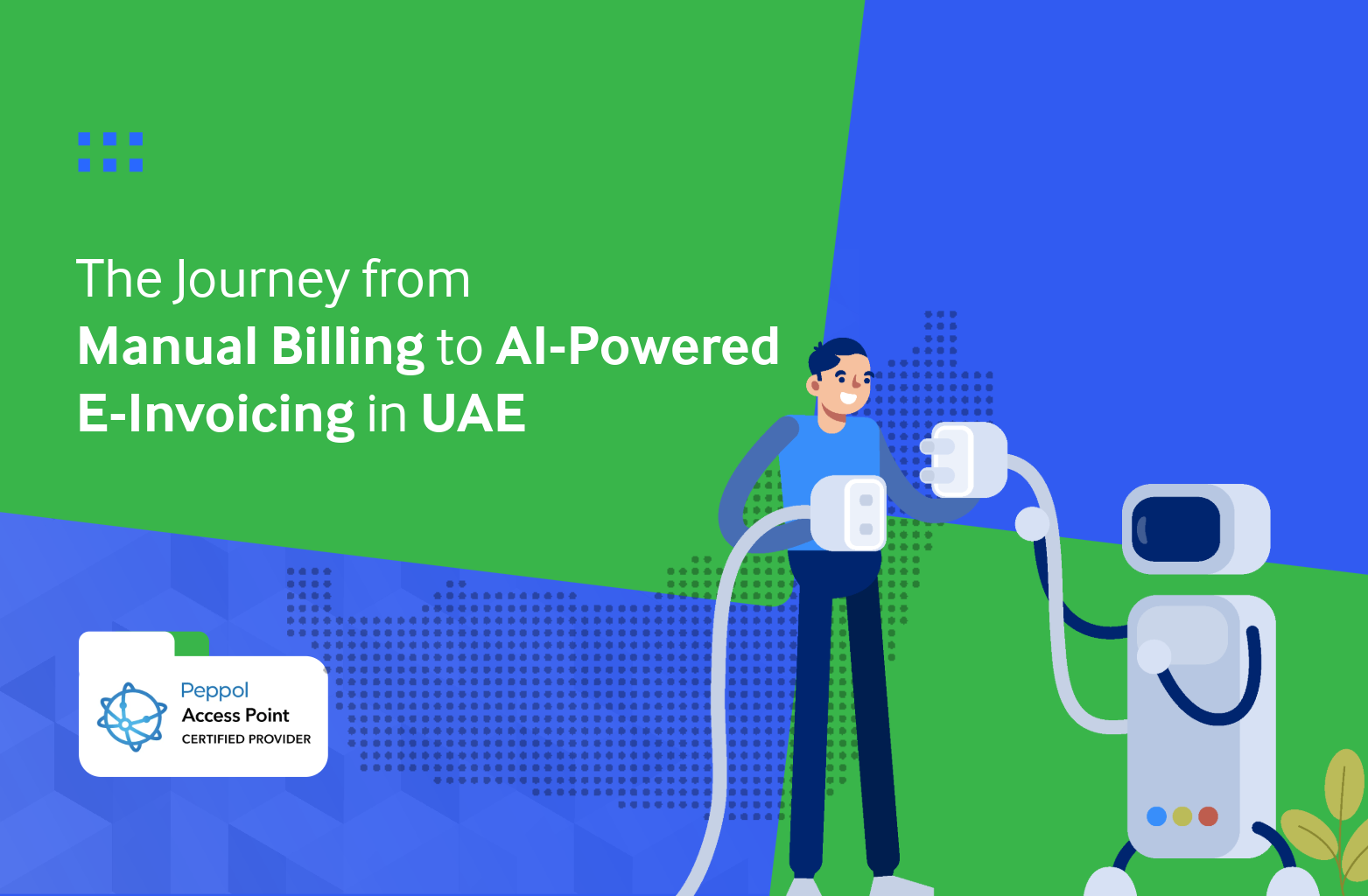
The Journey from Manual Billing to AI-Powered E-Invoicing in UAE

If you’ve been doing business in the UAE for more than a decade, you’ve witnessed a remarkable transformation. Remember manually typing invoices, printing them in triplicate, and waiting anxiously for the courier to arrive? Those days feel like ancient history now, yet many of us can still recall the frustration of misplaced paperwork and endless filing cabinets.

The shift from manual billing to AI-powered e-invoicing hasn’t just changed how we send invoices—it’s fundamentally transformed how businesses operate in the Emirates. This is that journey, and if you’re still relying on older methods, it might just convince you it’s time to take the leap.

The Era of Manual Invoicing: Where It All Began

Let’s be honest: manual invoicing was a nightmare. Back in the early 2010s, a typical UAE business would spend hours each week just preparing invoices. You’d open your accounting software (or worse, an Excel spreadsheet), manually enter customer details, line items, VAT calculations, and pray you didn’t make typos.

Then came the printing, signing, stamping, and courier services. The costs added up quickly—paper, ink, staff time, storage space, and inevitable errors requiring credit notes and revised invoices.

One textile trader in Deira told me he employed two full-time staff just managing physical invoices. “We had a room that was just filing cabinets,” he recalled. “Floor to ceiling, wall to wall. It was insane.”

The problems went beyond inconvenience. Manual processes meant delayed payments, lost invoices, disputes over whether payments were made, and compliance nightmares during tax audits. When UAE introduced VAT in 2018, many businesses realized their manual systems simply couldn’t handle the complexity.

With SmarteIS from  Skill Quotient Technologies , businesses can enjoy a seamless invoicing experience that combines user-friendly design, automation, customization, integration, compliance, and insightful analytics—all in one powerful solution.

Book a Demo

The First Wave: Basic Digital Solutions

The initial shift to digital invoicing felt revolutionary. PDF invoices sent via email seemed to solve all our problems—no more printing, no more courier costs, instant delivery.

But those early solutions were essentially digitized paper invoices. You’d still create invoices manually, save them as PDFs, and email them. Sure, you saved on paper and delivery, but you hadn’t solved the fundamental problems of manual data entry, human error, or workflow inefficiencies.

Your customers would receive PDFs, print them (defeating the purpose), or save them in folders that quickly became as disorganized as old filing cabinets. Accounts payable teams still had to manually enter invoice data. We’d eliminated physical paper but not the underlying inefficiencies.

The Federal Tax Authority’s stringent requirements highlighted another problem: these basic solutions weren’t designed for compliance. When regulations changed, businesses had to manually update invoice templates and hope they hadn’t missed anything triggering penalties.

The E-Invoicing Revolution in UAE

The real transformation began when the UAE government recognized that true digitalization required more than PDF files. The Federal Tax Authority developed frameworks for proper e-invoicing—structured data that could be automatically validated, processed, and integrated with government systems. This wasn’t just about convenience. It was about creating a transparent, efficient tax system that could track transactions in real-time, reduce tax evasion, and make life easier for compliant businesses.

For businesses, this meant finding FTA-compliant e-invoicing solutions that could handle structured data formats, integrate with accounting systems, and automatically submit required information. The best e-invoicing software in UAE needed sophistication to handle complex requirements while remaining simple enough for small businesses. One restaurant chain owner told me: “We’d just gotten comfortable with our PDF invoices. Now we needed to learn a whole new system, integrate it with our POS, and ensure every invoice met FTA requirements. It felt overwhelming.” But something interesting happened. Once businesses implemented proper FTA-accredited e-invoicing software in UAE, they discovered unexpected benefits. Invoice processing times dropped dramatically. Payment cycles shortened. Disputes decreased because data was structured and clear. And businesses gained operational insights they’d never had before.

AI-Powered E-Invoicing: The Game Changer

Just when e-invoicing seemed to have peaked, artificial intelligence changed everything. We’re now in 2026, and AI-powered solutions are doing things that seemed like science fiction five years ago.

Today’s top e-invoicing solution in UAE doesn’t just create and send invoices—it thinks, learns, and adapts. Here’s how this works in practice:

  1. Smart Data Entry: AI automatically recognizes customers, pulls in their details, and suggests products or services based on past history. One maintenance services company reduced invoice creation time by 75% as the system auto-fills data using learned patterns.
  2. Intelligent Error Detection: Before sending an invoice, AI checks for inconsistencies such as incorrect VAT rates, mismatched addresses, or unusual changes. This prevents errors and avoids awkward corrections later.
  3. Predictive Payment Insights: AI analyzes customer payment behavior to predict when invoices will be paid.
    It highlights customers likely to delay payments and supports proactive cash-flow planning—like a crystal ball for accounts receivable.
  4. Automated Follow-ups: The system sends personalized reminders based on how each customer typically responds. Businesses have seen a 30–40% improvement in on-time payments through intelligent follow-ups.
  5. Compliance Monitoring: AI continuously tracks regulatory updates and automatically adjusts invoicing processes. When FTA requirements change, the system adapts without manual intervention—ensuring compliance and peace of mind.

Choosing Your E-Invoicing Partner

The challenge today isn’t whether to adopt e-invoicing—regulations have decided that. The real question is choosing the right e-invoicing partner for your needs.

Common mistakes include going with the cheapest option without considering functionality, or choosing overcomplicated enterprise solutions when simpler options suffice. You don’t need a Formula 1 race car for driving to the grocery store.

When evaluating e-invoicing solution providers, look for:

  1. Compliance First: Your solution must be FTA-accredited. Verify their accreditation status—don’t just take their word for it.
  2. Integration Capability: The e-invoicing solution in UAE should integrate seamlessly with your accounting software, inventory management, and CRM. Poor integration defeats the purpose through duplicate data entry.
  3. Scalability: Choose solutions that grow with you. Handle ten invoices monthly or ten thousand without switching platforms.
  4. User Experience: If staff find the system difficult, they’ll resist it. The interface should be intuitive. Have actual users test before committing.
  5. Support Quality: When problems arise, you need responsive support. Check reviews and ask about response times. Cheap solutions aren’t cheap if you’re stuck waiting for help during month-end.
  6. Real AI Features: Not all “AI-powered” solutions are equal. Ask specific questions: What does the AI actually do? How does it learn? What predictions can it make?

Implementation Reality

Let’s be honest about what implementing modern e-invoicing looks like. It’s not plug-and-play magic.

The first few weeks are typically roughest. Your team learns the new system, data migrates from old systems, integrations get configured, and templates get customized. Expect a month adjustment period where productivity might decrease slightly before dramatically improving.

Good e-invoicing solution providers guide you through this. They help with data migration, train your staff, and provide transition support. If a provider just hands you login credentials and wishes you luck, that’s a red flag.

One Dubai logistics company had a smooth transition using a phased approach. They ran new and old systems simultaneously for a month, gradually shifting invoices as their team gained confidence. By month two, they’d completely switched. By month three, they wondered how they’d ever managed before.

Real Results from Real Businesses

A construction materials supplier in Abu Dhabi reduced invoice processing from 15 minutes to under two minutes per invoice. For 500 monthly invoices, that’s over 100 hours saved monthly—two and a half full-time employees’ worth of productivity.

A restaurant group saw average days sales outstanding drop from 45 to 28 days after implementing AI-powered payment prediction and automated follow-ups. This cash flow improvement allowed them to open a new location six months earlier than planned.

A mid-sized trading company being audited by FTA generated complete audit reports in under an hour with their FTA compliant e-invoicing solution—a process that would have taken weeks previously. The auditor was impressed, and they passed without issues.

What's Next?

We’ve come far from rooms full of filing cabinets, but the journey continues. I’m already seeing blockchain integration for immutable invoice records, more sophisticated AI handling complex multi-currency transactions, and tighter buyer-supplier system integration creating almost automated supply chains.

But here’s what matters most: the fundamental mindset shift. We’ve moved from seeing invoicing as administrative burden to recognizing it as strategic business function providing valuable insights. Modern e-invoicing systems don’t just process transactions—they provide intelligence helping businesses make better decisions.

Making the Move

If you’re still using manual processes or basic digital solutions, you’re not just behind—you’re actively handicapping your business. The good news? It’s never too late to change.

Start by honestly assessing your current situation. How much time do you spend on invoicing? How often do errors occur? What’s your average payment cycle? Then talk to e-invoicing solution providers, see demos, and ask lots of questions. The right partner will understand your business rather than just sell software.

The journey from manual billing to AI-powered e-invoicing in UAE has transformed businesses that embraced it. Yes, there’s initial investment of time and money. Yes, there’s a learning curve. But the alternative—sticking with outdated processes in an increasingly digital economy—simply isn’t viable.

The future of UAE business is digital, intelligent, and connected. E-invoicing isn’t just about compliance or efficiency anymore—it’s about positioning your business to thrive. Thousands of UAE businesses have made this journey successfully. Most only wish they’d done it sooner.

FAQ

Frequently Asked Questions about e-Invoicing

AI-powered e-invoicing in UAE refers to digital invoicing systems that use artificial intelligence to automate invoice creation, validation, compliance checks, payment predictions, and follow-ups while meeting Federal Tax Authority requirements.

Yes. UAE is implementing mandatory e-invoicing in phases as part of its digital tax transformation. Businesses must adopt FTA-compliant e-invoicing solutions to meet upcoming regulatory requirements and avoid penalties.

Unlike PDF or Excel invoices, AI-powered e-invoicing uses structured data, automated validation, real-time compliance checks, and intelligent workflows—reducing errors, speeding up payments, and ensuring regulatory alignment.

All VAT-registered businesses—SMEs, enterprises, retailers, restaurants, logistics firms, and trading companies—will require compliant e-invoicing systems, especially those handling high invoice volumes or complex VAT scenarios.

Key benefits include faster invoice processing, reduced manual errors, shorter payment cycles, automated compliance, predictive cash-flow insights, and lower operational costs.

AI continuously validates invoices against FTA rules, monitors regulatory changes, auto-updates invoice formats, and flags non-compliant data—helping businesses stay audit-ready without manual intervention.

Yes. Modern e-invoicing solutions in UAE integrate seamlessly with ERP systems, accounting software, POS systems, and CRMs to eliminate duplicate data entry and streamline financial operations.

Reputable UAE e-invoicing platforms use enterprise-grade security, encryption, role-based access controls, and secure data centers to protect invoices, customer data, and tax information.

Implementation typically takes 2–6 weeks, depending on business size, integrations, and data migration. Most providers recommend a phased rollout to ensure smooth adoption and minimal disruption.

Look for FTA accreditation, strong AI capabilities (not just branding), easy integrations, scalability, intuitive UI, reliable support, and proven experience with UAE compliance requirements.